
Size
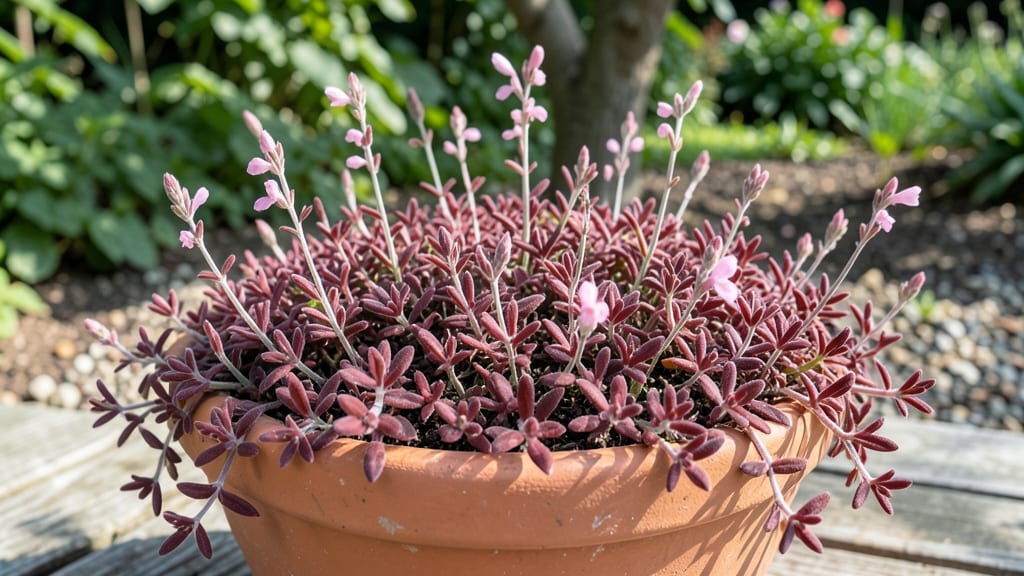
Red creeping thyme relies heavily on sunlight to maintain its signature deep red color and compact growth habit. 🌿 Without adequate light, the plant's chlorophyll production slows, leading to paler leaves and weaker stems.
I’ve noticed that even partial shade can work if the plant gets morning sun, but full shade often causes it to stretch out unnaturally, making it look less lush.
If you’re working with a shady garden, consider mixing it with shade-tolerant companions like ajuga or creeping jenny to create a balanced, vibrant ground cover.
For those determined to grow red creeping thyme in low-light conditions, I recommend starting with a well-draining soil mix and avoiding overwatering—this helps compensate for the lack of sunlight.
However, the trade-off is usually noticeable: the plant may never reach its full potential in terms of color intensity or bloom frequency. If you love the look of thyme but have limited sun, varieties like woolly thyme or lemon thyme might be more forgiving alternatives.
💡 In This Article
- Light Requirements for Healthy Red Creeping Thyme Growth
- Shade-Tolerant Alternatives for Low-Light Gardens
Light requirements for healthy red creeping thyme growth
Red creeping thyme thrives on sunlight because its vibrant red foliage comes from anthocyanin pigments, which require photosynthesis efficiency to maintain their intensity. In full shade, chlorophyll production slows dramatically, causing leaves to lose their deep red hue and turn greenish-gray.
Studies show that plants in low-light conditions allocate more energy to survival than pigment production, weakening the plant's structural integrity and reducing its ornamental value. 🌿
The ideal light spectrum for red creeping thyme includes 4-6 hours of direct sunlight daily, with the remaining hours in partial shade. This balance allows the plant to perform efficient photosynthesis while preventing heat stress.
In contrast, full shade environments (receiving less than 2 hours of sunlight) force the plant to stretch its stems toward any available light—a phenomenon called etiolation. This results in weak, leggy growth that’s prone to breaking and lacks the dense, carpet-like appearance gardeners love.
For gardeners with limited sunlight, consider dappled sunlight—filtering through tree canopies—where the plant receives bright, indirect light for most of the day. This mimics the natural understory conditions of Mediterranean climates, where thyme originally evolved.
The key is ensuring the plant gets at least 3-4 hours of direct sunlight, even if spread out over morning and late afternoon. Without this, the plant’s growth rate slows by up to 50%, and blooms become sparse or nonexistent.
Another critical factor is light intensity. Red creeping thyme prefers full-spectrum sunlight, which provides the blue and red wavelengths essential for anthocyanin production.
In shaded areas, artificial grow lights with a 10,000K color temperature can supplement natural light, but they must be placed 6-12 inches above the plant for effectiveness. Without adequate light, the plant’s metabolic processes slow, leading to stunted roots and reduced disease resistance.
To test your garden’s light conditions, use a lux meter (measuring light intensity in lux). Red creeping thyme performs best in areas with 10,000-20,000 lux during peak sunlight hours.
In full shade, readings often drop below 5,000 lux, which is insufficient for maintaining the plant’s characteristic red color and compact growth. If your garden falls short, consider relocating the thyme to a sunnier spot or pairing it with shade-tolerant companions that thrive in lower light.
One common mistake is assuming "partial shade" means deep shade with minimal sunlight. True partial shade should provide 3-6 hours of direct light, while the rest is filtered shade.
For example, planting near a deciduous tree (like an oak or maple) allows thyme to receive morning sun while avoiding harsh afternoon heat. This approach preserves the plant’s health and vibrancy without compromising its structural integrity. 🌱