
Light Requirements
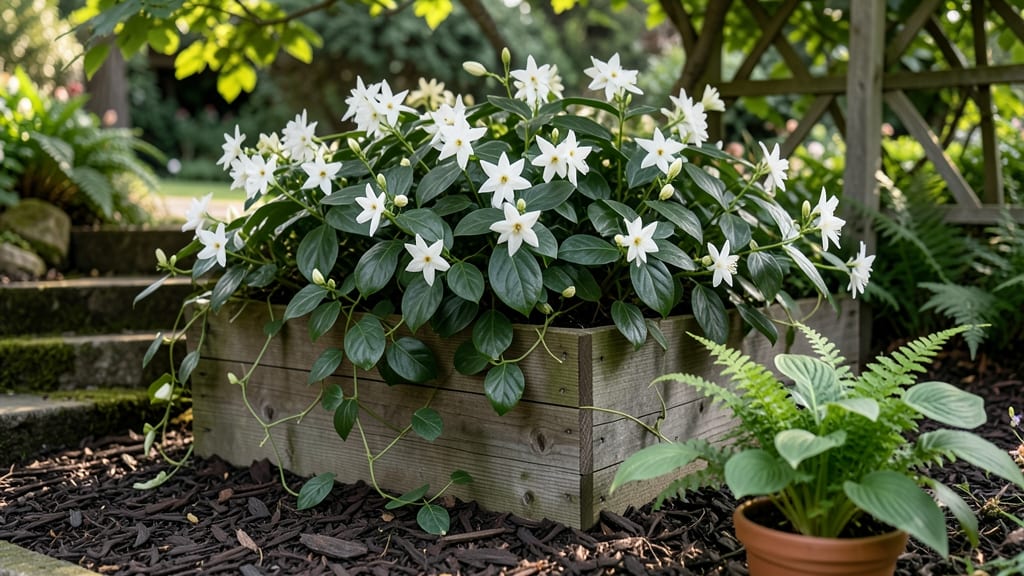
Can star jasmine grow in shade? Yes, but it thrives best in partial shade to full sun, tolerating dappled light or filtered sunlight while producing fewer blooms in deep shade. Ensure well-draining soil and consistent moisture for optimal growth.
Star jasmine is surprisingly adaptable to lower light conditions, making it a favorite for shaded gardens. 🌿 The key lies in its ability to survive with reduced sunlight, though it won't bloom as prolifically in deep shade.
I've seen it thrive under large trees where other flowering vines struggle, though the leaves may become less vibrant. For best results, position it where it gets at least 3-4 hours of morning sun—this balance encourages healthy foliage while still allowing some flowering potential.
What's interesting is how star jasmine responds to different light levels. In full sun, you'll get that signature heavy fragrance and abundant blooms, but in partial shade, the plant focuses its energy on maintaining strong vines rather than producing flowers.
This makes it perfect for areas where full sun isn't an option, like north-facing walls or under deciduous trees. The trade-off is worth it for many gardeners who prioritize lush growth over maximum blooming.
💡 In This Article
- Star Jasmine Light Requirements: How Shade Affects Growth and Blooming
- Optimizing Star Jasmine Care in Low-Light Conditions
Star jasmine light requirements: how shade affects growth and blooming
Star jasmine's ability to survive in shade comes down to its photosynthetic efficiency and chlorophyll adaptation. Unlike sun-loving plants that produce more chlorophyll to capture light, star jasmine has a moderate chlorophyll content that allows it to function with 30-50% of full sunlight.
In deep shade (less than 3 hours of light daily), the plant shifts energy toward leaf maintenance rather than flower production, resulting in fewer blooms but denser foliage. This is why you'll often see star jasmine thriving under trees where other flowering vines would struggle.
The science behind this involves photosynthesis thresholds. Star jasmine's leaves contain chlorophyll a and b, but in low light, the plant prioritizes chlorophyll a production since it's more efficient in dim conditions.
This adaptation explains why star jasmine remains green in shade, though the leaves may appear darker and thicker. In contrast, full sun exposure triggers higher anthocyanin production (the pigments responsible for vibrant colors), which is why blooms in sunny conditions are more fragrant and visually striking.
Growth patterns differ dramatically between light conditions. In full sun (6+ hours daily), star jasmine grows 2-3 feet per year with abundant blooms, while in partial shade (3-5 hours daily), growth slows to 1-2 feet annually but maintains bushier structure.
The trade-off is clear: shade preserves the plant's structural integrity but sacrifices flowering potential. For example, a star jasmine vine in a north-facing garden will produce 30-50% fewer flowers than one in a south-facing location, but the leaves will remain healthier and less prone to scorching.
What most gardeners don't realize is how light quality matters just as much as quantity. Star jasmine benefits from dappled or filtered sunlight (like through tree canopies) because it provides a balance of direct and indirect rays.
Pure shade from solid structures (like brick walls) creates a "light starvation" effect, where the plant stretches toward any available light, leading to leggy, weak growth. This is why positioning near deciduous trees—where light shifts with seasons—often yields better results than dense evergreen shade.
Another key factor is the photoperiod response. Star jasmine, like many flowering plants, uses daylight length to trigger blooming. In deep shade, shorter effective daylight hours confuse the plant's internal clock, delaying or reducing flower production.
For instance, a vine receiving only 2 hours of morning sun may bloom 4-6 weeks later than one in full sun, or not at all in some cases. This explains why late-season blooms are often less abundant in shaded plants.
To visualize this, imagine two star jasmine vines: one basking in afternoon sun, producing 100-200 flowers per season with intense fragrance, and another under a maple tree, yielding 50-100 flowers but with lusher, darker green leaves. The difference isn't just quantity—it's energy allocation.
In shade, star jasmine invests in cellulose and starch storage for survival, while in sun, it prioritizes floral reproduction. Understanding this helps explain why some gardeners prefer shade-grown star jasmine for its foliage alone.