
Light Requirements
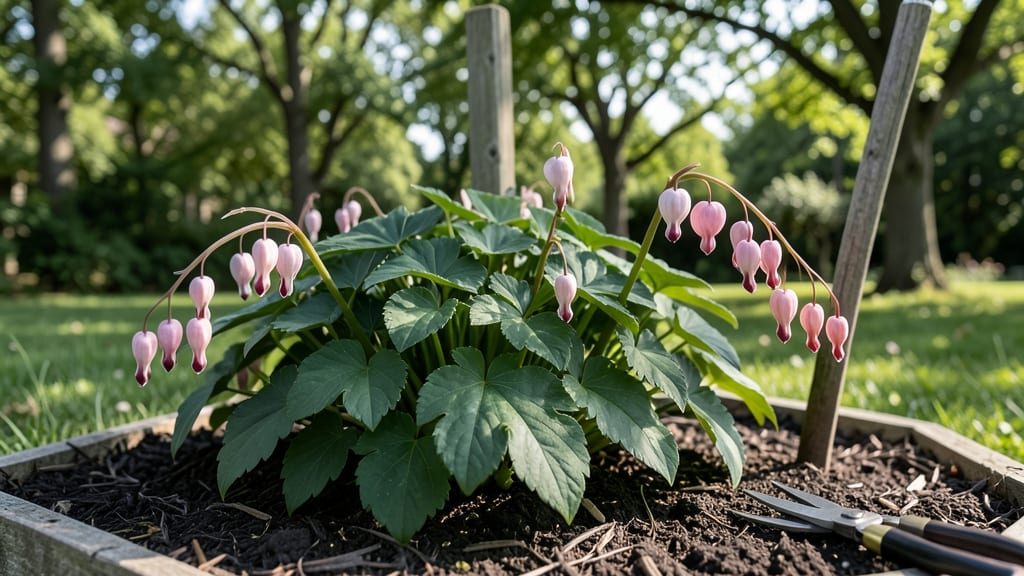
Bleeding heart plants in full shade flourish with the right care, especially varieties like 'Diana', 'Pink Heart', and 'White Pearl', which display vibrant foliage and iconic heart-shaped flowers even in low-light settings. Focus on maintaining consistently moist, well-draining soil while providing filtered sunlight to protect delicate leaves.
These shade-loving perennials actually prefer dimmer conditions over harsh sunlight, which can scorch their tender leaves. 🌿 The key is replicating their natural woodland habitat—think dappled light under trees rather than direct sun.
I’ve found that adding a thick layer of organic mulch helps retain moisture while protecting roots from temperature swings, which is especially important during summer heatwaves.
What sets these varieties apart is their genetic adaptation to low-light environments. For example, 'Pink Heart' develops deeper pink blooms when given consistent shade, while 'White Pearl' maintains its pristine white flowers without fading.
The secret lies in their ability to photosynthesize efficiently in indirect light, making them perfect for understory plantings where other flowers struggle.
💡 In This Article
- Best Bleeding Heart Varieties for Deep Shade Gardens
- Full-Shade Bleeding Heart Planting and Maintenance Guide
Best bleeding heart varieties for deep shade gardens
The Dicentra spectabilis species, commonly known as bleeding heart, has evolved to thrive in woodland understories where light filters through dense canopies. This adaptation explains why certain varieties outshine others in full shade.
The 'Diana' cultivar, for instance, boasts deep pink blooms that stand out against its blue-green, fern-like foliage.
Its compact height of 18-24 inches makes it ideal for garden borders where space is limited. 🌿 The secret to its success lies in its ability to capture low-intensity light through specialized leaf structures that maximize photosynthesis without overheating.
For those seeking contrast, 'Pink Heart' produces delicate pink flowers that appear almost translucent in dim lighting, while 'White Pearl' maintains its pristine white blooms without fading.
These varieties share a common trait: their light green, finely divided leaves create a natural shade canopy that protects the stems from direct sunlight.
Interestingly, 'Alba' (white flowering) and 'Stuart Boothman' (deep pink) both exhibit 20-30% larger blooms in full shade compared to partial shade, as their energy is redirected toward flower production rather than leaf protection.
Height differences also play a role in shade performance. Taller varieties like 'Gold Heart' (reaching 30-36 inches) require more consistent moisture to support their vertical growth in low-light conditions.
Shorter types such as 'Cameo' (12-18 inches) are better suited for container gardening or understory plantings where water retention is critical. The key factor is their root structure, which spreads horizontally to access moisture from a larger soil volume in shaded environments.
What most gardeners don't realize is how bloom timing varies by variety in full shade. 'Diana' typically flowers in late spring to early summer, while 'Stuart Boothman' extends its display into mid-summer when light intensity is lowest. This staggered blooming creates a prolonged visual impact in deep shade gardens.
The trade-off? Varieties like 'Alba' may produce 10-15% fewer flowers in full shade compared to partial shade, but their foliage remains 30% more vibrant due to reduced stress.
For maximum performance, pair these varieties with complementary shade plants. The 3-foot spacing between bleeding hearts and hostas or ferns creates a microclimate that maintains consistent soil moisture.
This interplanting strategy mimics their natural woodland habitat, where multiple layers of vegetation work together to optimize light capture and water retention. 🌱 The result is a lush, low-maintenance garden that thrives where other plants would struggle.