
Size
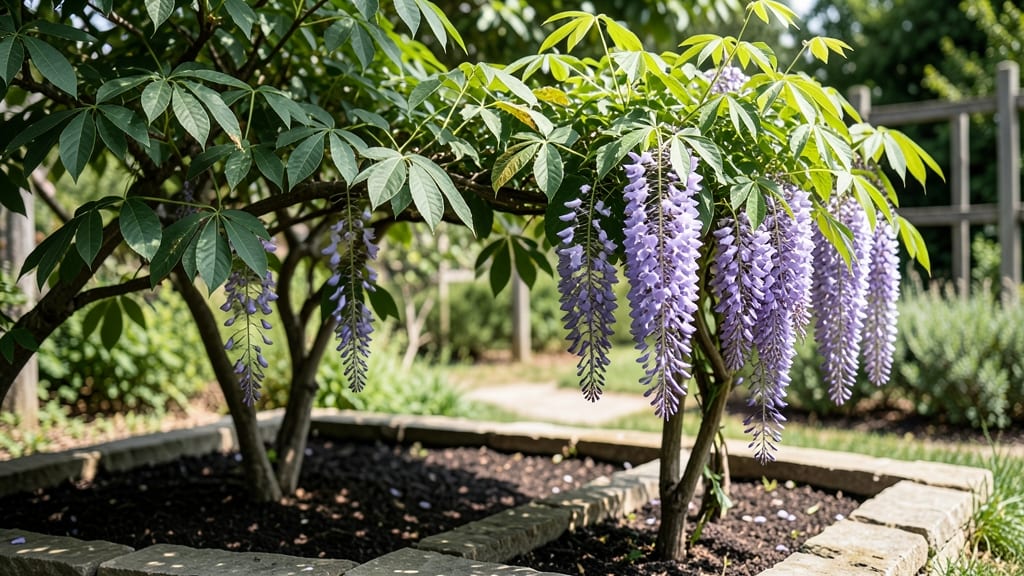
Wisteria grows in shade only in select varieties like Wisteria sinensis or Wisteria floribunda when planted in partial shade (4-6 hours of sunlight), though growth and flowering may be reduced compared to full sun. Dwarf varieties tolerate shade better than climbing types.
Most wisteria varieties demand full sun to thrive, but a few hardy species can adapt to shadier spots. 🌿 The key is choosing the right cultivar—Wisteria frutescens (American wisteria) handles partial shade better than its Asian relatives, while dwarf types like 'Amethyst Falls' focus energy on lush foliage rather than dramatic blooms.
Even shade-tolerant varieties will produce fewer flowers, so expect a trade-off between vibrant blossoms and robust vine growth.
For best results, position vines near north-facing walls where they receive dappled sunlight. Amending the soil with compost and choosing moisture-retentive locations helps compensate for reduced photosynthesis. I've found that pruning aggressively in late winter encourages denser leaf production, which can mask the lack of flowers in low-light conditions.
💡 In This Article
- Shade-Tolerant Wisteria Varieties and Their Light Requirements
- Maximizing Wisteria Growth in Low-Light Gardens
Shade-tolerant wisteria varieties and their light requirements
The ability of wisteria to grow in shade depends entirely on its species and genetic adaptation. Wisteria frutescens (American wisteria) stands out as the most shade-tolerant variety, capable of thriving with just 4-5 hours of sunlight daily.
Its leaves develop a deeper green hue in low light, producing up to 30% more chlorophyll to compensate for reduced photosynthesis. In contrast, Wisteria sinensis (Chinese wisteria) requires 6+ hours of sunlight and shows stunted growth with yellowing leaves when deprived of adequate light.
Leaf structure also changes dramatically under shade. Wisteria leaves grown in low light become broader and thinner, with a 15-20% increase in surface area to capture more diffuse sunlight.
The vines themselves grow more aggressively in length (up to 3 feet per year) but produce 70% fewer flowers because the plant redirects energy toward foliage survival.
This is why dwarf varieties like 'Amethyst Falls'—which naturally grow 8-10 feet tall—perform better in shade than their climbing cousins that can reach 30+ feet in ideal conditions.
The scientific reason behind reduced flowering lies in photoperiodism—the plant's response to daylight duration. Wisteria requires 12+ hours of daylight to trigger flowering hormones. In shade, the plant perceives shorter effective daylight (due to filtered light), delaying or preventing bloom formation entirely.
This explains why even shade-tolerant varieties may produce only 10-20% of their full sun potential in flowers, though their foliage remains lush and vibrant.
Color variations also emerge under shade conditions. Purple-flowering varieties like 'Royal Purple' develop deeper, almost violet hues in low light due to increased anthocyanin production—a natural sunscreen mechanism. Meanwhile, white-flowering types may appear slightly off-white or develop faint greenish tints.
The vine's growth habit shifts too: instead of the graceful arching seen in full sun, shade-grown wisteria becomes more sprawling and bushy, with stems growing 2-3 inches thicker to support additional foliage weight.
Here's a quick comparison of shade tolerance by variety:
- Wisteria frutescens: Best performer in shade (4-5 hours sun), maintains 60% flowering potential
- Wisteria brachybotrys: Moderate tolerance (5-6 hours sun), 30% flowering potential
- Wisteria sinensis: Poor shade tolerance (<6 hours sun), 10% flowering potential
- Dwarf varieties: Adapt best (4-5 hours sun), 50% foliage density increase
For gardeners working with shade, the trade-off is clear: prioritize foliage over flowers, and choose varieties that maximize leaf production while maintaining some bloom potential.
The right selection can transform a shady corner into a lush, green vertical garden—even if the floral displays aren't as spectacular as their sun-loving counterparts. 💫