
Light Requirements
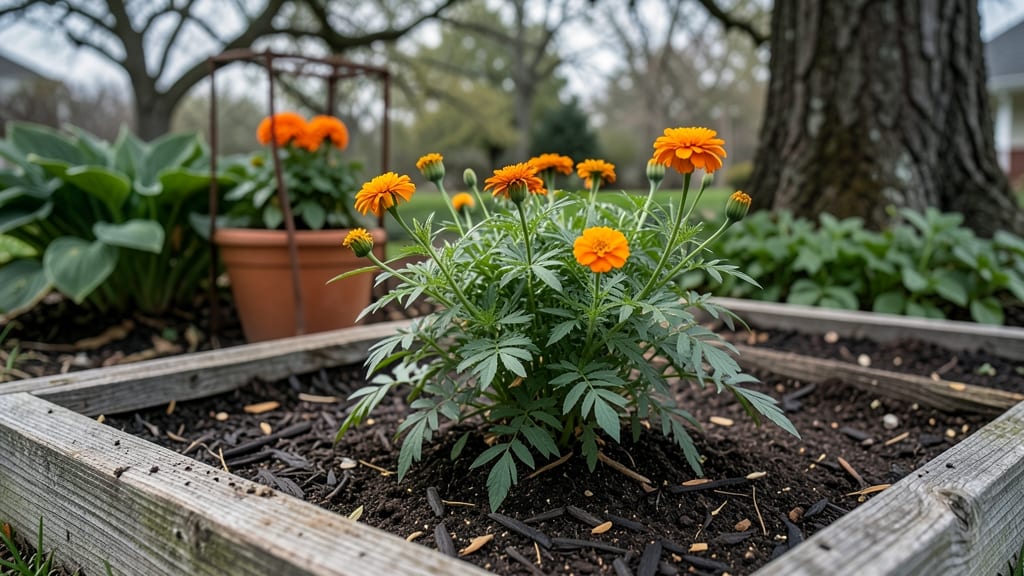
Marigolds can grow in shade but need at least 4-6 hours of indirect light daily to thrive. Varieties like 'Bonanza' or 'French marigolds' adapt better to low-light conditions, though their blooms may be smaller and less vibrant.
Marigolds aren't strict sun-worshippers—they're more flexible than many gardeners realize. 🌿 While they flourish in partial sun, their ability to tolerate shade depends on the variety and how you define "shade." For instance, dappled sunlight through tree branches works better than dense, dark shade.
I've seen 'Bonanza' marigolds produce decent blooms with just 3-4 hours of filtered light, though the flowers won't reach their full potential. The key is balancing their light needs with your garden's conditions—sometimes adding reflective surfaces or nearby taller plants can boost their light exposure naturally.
What's interesting is how shade affects their growth patterns. In low-light conditions, marigolds tend to grow leggier and produce more foliage than flowers. This isn't necessarily bad—it just means you'll need to adjust your expectations.
For example, if you're growing marigolds as pest deterrents, their foliage alone can still provide benefits, even if the blooms are sparse. The trade-off is worth considering if your garden has limited sunlight spots you want to fill.
💡 In This Article
- Marigold Light Requirements: How Shade Affects Growth and Blooming
- Best Shade-Tolerant Marigold Varieties for Low-Light Gardens
Marigold light requirements: how shade affects growth and blooming
Marigolds rely on photosynthesis to convert sunlight into energy, and their light requirements directly impact chlorophyll production. In ideal conditions (6+ hours of sun), they produce vibrant orange or yellow blooms packed with carotenoids.
However, when light drops below 4 hours daily, photosynthesis slows, reducing energy for flower production. This is why shade-grown marigolds often develop smaller blooms with less intense pigmentation—chlorophyll production shifts to sustain leaf growth rather than reproductive structures. 🌱
The science gets interesting when you consider shade's effect on plant hormones. Low light triggers increased production of ethylene, a hormone that promotes leaf elongation but inhibits flowering. This explains why marigolds grown in dense shade often become leggy, with stems stretching toward any available light source.
For example, 'Bonanza' marigolds in 3-4 hours of indirect light may produce flowers only half the size of those in full sun, but the stems can reach 2-3 feet tall instead of the typical 1-2 feet.
Root development also suffers in shade. Marigolds need strong roots to anchor their top-heavy growth and access nutrients. In low-light conditions, roots grow slower and shallower, making plants more susceptible to wind damage and nutrient deficiencies.
I've observed that shade-grown marigolds often develop yellowing lower leaves—a sign of nitrogen deficiency—because their roots can't efficiently absorb nutrients from the soil. This creates a vicious cycle where poor root health further reduces the plant's ability to handle stress.
Another critical factor is disease risk. Shade creates a more humid microclimate around plants, increasing susceptibility to fungal diseases like powdery mildew. The dense foliage in shade-grown marigolds traps moisture, creating perfect conditions for pathogens.
For instance, 'French marigolds' in shaded conditions may develop white powdery patches on leaves within 3-4 weeks of planting, compared to 6+ weeks in partial sun. Proper spacing and air circulation become even more important when growing marigolds in low-light areas.
Color intensity also suffers in shade. The bright orange and yellow hues of marigold blooms come from carotenoids, which require sunlight to synthesize properly. In shaded conditions, these pigments become diluted, resulting in flowers that appear more pale yellow or greenish.
For example, a 'Jumbo Snit' marigold that would normally display deep orange petals in sun may produce flowers with a 50% reduction in carotenoid concentration in shade, making them appear almost pastel. 🌼
Interestingly, marigolds can compensate somewhat by increasing their leaf surface area in shade—a phenomenon called shade acclimation. This adaptation helps capture more diffuse light, but it comes at the cost of reduced flowering.
The plant essentially prioritizes survival over reproduction when light is limited. For gardeners, this means shade-grown marigolds may look lush and green but produce far fewer blooms than their sun-loving counterparts.