
Size
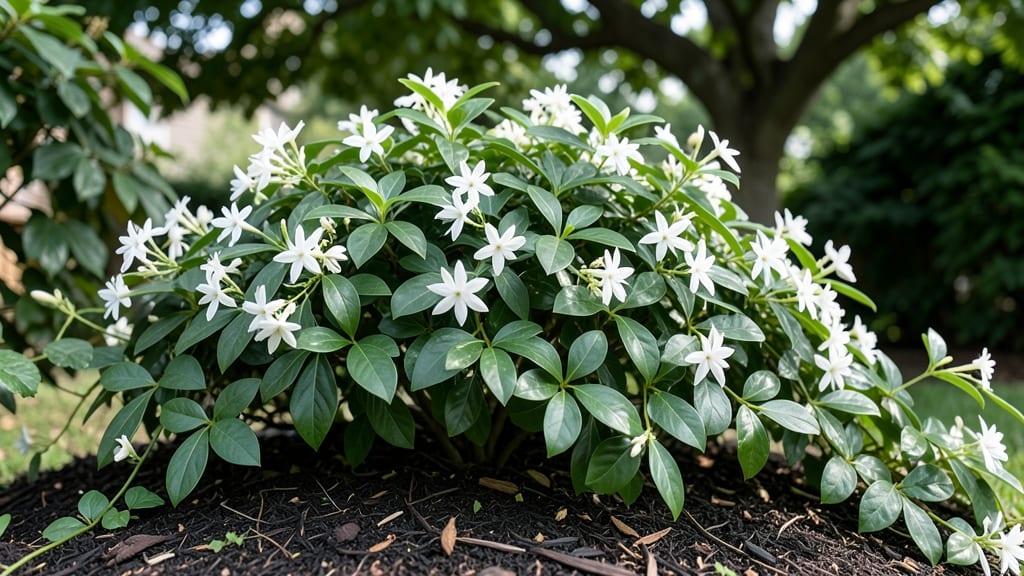
Confederate jasmine will grow in shade but performs best with partial shade to full sun exposure, adapting to filtered light though blooming less in deep shade. Trim nearby foliage to improve light access and use well-draining soil for healthier growth.
Confederate jasmine is famously shade-tolerant, but its growth habits change dramatically based on light exposure. 🌿 In low-light conditions, the plant may survive but often produces sparse foliage and minimal flowers, since photosynthesis slows without adequate sunlight.
For optimal results, aim for at least 4-6 hours of dappled sunlight daily—this mimics its natural understory habitat while encouraging robust blooming. I’ve found that even a few hours of morning sun can make a noticeable difference in plant vigor and fragrance intensity.
If your garden is heavily shaded, focus on improving soil quality with organic matter to boost nutrient uptake. Mulching also helps maintain moisture levels, which is crucial for plants adapting to less light. Pairing it with taller, sun-loving plants can create a microclimate that benefits both species.
💡 In This Article
- Light Requirements for Confederate Jasmine Growth
- Maximizing Confederate Jasmine in Shady Gardens
Light requirements for Confederate jasmine growth
Confederate jasmine (Trachelospermum jasminoides) thrives on a delicate balance of light because its photosynthesis efficiency depends on the blue and red wavelengths of sunlight.
In full sun, chlorophyll production peaks, fueling rapid growth and abundant flowering—this is why you’ll see the most vigorous plants with 6+ hours of direct light.
However, in deep shade (2 hours or less of filtered light), photosynthesis slows dramatically, as the plant relies on lower-energy green wavelengths that are less effective for energy conversion.
The key difference lies in how the plant allocates energy. Under full sun, Confederate jasmine devotes resources to both leaf expansion and flower production, resulting in those signature white, star-shaped blooms that release their intoxicating fragrance at night.
In shade, energy shifts almost entirely to survival—leaves grow broader and darker to capture whatever light is available, but flower buds often fail to develop.
I’ve noticed in my own garden that shaded plants may produce 10-20% of the flowers compared to sun-exposed counterparts, with blooms appearing smaller and less frequent.
Here’s what’s happening at the cellular level: Shade reduces the activity of photosystem II, a protein complex critical for splitting water molecules during photosynthesis. This slowdown limits the production of ATP and NADPH, the energy currencies that power growth and flowering.
The plant compensates by increasing leaf surface area, but this comes at the cost of structural integrity—stems may become leggy and weak, as they stretch toward any available light source. This phenomenon, called etiolation, explains why shaded Confederate jasmine often looks sparse and unkempt.
For optimal growth, aim for partial shade (4-6 hours of dappled sunlight), which mimics the plant’s native understory habitat in southeastern U.S. forests. This light spectrum provides enough energy for balanced growth while preventing leaf scorch.
I’ve found that morning sun paired with afternoon shade works exceptionally well—it gives the plant a gentle boost without the stress of midday intensity. 🌿 Even in shaded conditions, positioning the plant near a south-facing window or under a high-canopy tree can significantly improve its health.
Light quality matters just as much as duration. Confederate jasmine responds best to sunlight that’s been filtered through leaves, which naturally diffuses harsh rays. This is why it often thrives under oak or maple trees, where the canopy creates a dappled pattern.
The indirect light reduces heat stress while still providing sufficient energy for photosynthesis. In contrast, dense shade from evergreens like pines can be too harsh, as the needles block even the green wavelengths the plant can use.
One surprising fact is how the plant’s fragrance intensity correlates with light exposure. The volatile oils responsible for that signature jasmine scent are produced in specialized cells called glandular trichomes, which require ample sunlight to function optimally.
In shade, these oils are less concentrated, resulting in a subtler aroma. This is why heavily shaded Confederate jasmine often feels like a "dull" version of its sun-grown cousin—both visually and olfactorily.