
Light Requirements
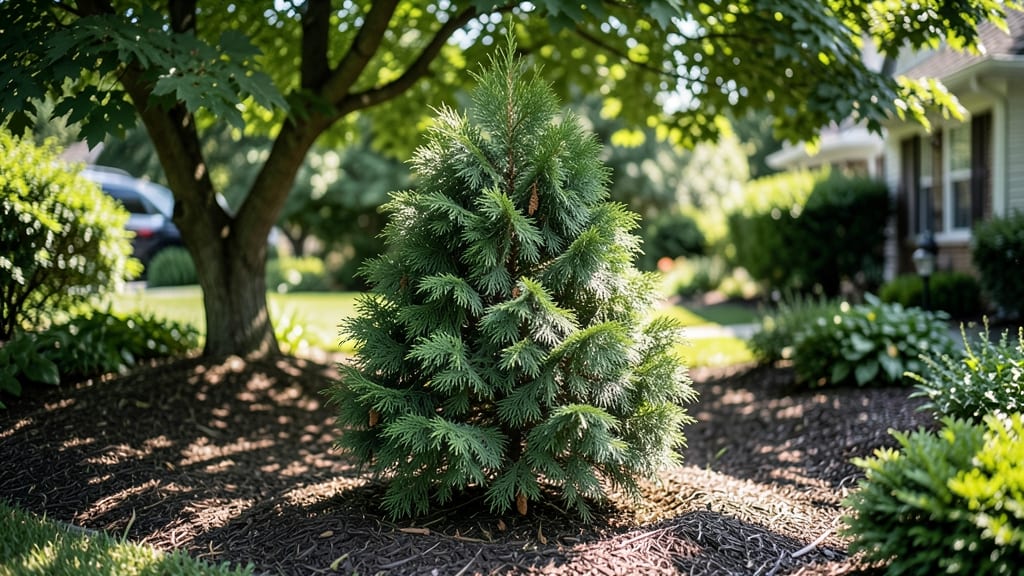
Thuja can grow in shade but thrives best in partial shade or filtered sunlight, with slower growth and potential needle browning in deep, dense shade. Choose shade-tolerant varieties like Thuja occidentalis 'Emerald Green' for optimal results.
While Thuja trees can survive in shaded areas, their growth rate and overall health depend heavily on light exposure. 🌿 In low-light conditions, photosynthesis slows down, leading to weaker root systems and less vigorous foliage.
This often results in yellowing or browning needles, especially in dense, dark shade where light barely penetrates. For best results, plant Thuja in spots with at least 3-4 hours of dappled sunlight daily—this balance helps maintain lush, green growth while avoiding stress.
If you're working with a heavily shaded landscape, opt for Thuja varieties bred for low-light tolerance. For example, Thuja occidentalis 'Emerald Green' handles shade better than standard types, while Thuja plicata 'Atrovirens' (Western Red Cedar) adapts well to moist, shady environments.
Mulching around the base with organic material can also improve soil moisture retention, compensating for reduced sunlight.
💡 In This Article
- How Shade Affects Thuja Growth and Health
- Best Thuja Varieties for Shady Gardens
How shade affects Thuja growth and health
Thuja trees rely on photosynthesis to convert sunlight into energy, and when placed in deep shade, their chlorophyll production drops dramatically. In areas receiving less than 30% of full sunlight, photosynthesis slows by up to 60%, forcing the plant to allocate more energy to survival than growth.
This creates a nutrient deficit, as the roots struggle to compensate with reduced photosynthesis output. The result? Needles turn yellow or brown at the tips—a clear sign of stress as the tree prioritizes keeping its core foliage alive over new growth.
The root system suffers too, as shade reduces soil microbial activity by 30-40%, limiting nutrient uptake. Without adequate light, Thuja can't produce enough glucose to sustain healthy roots, leading to shallow, weak systems that fail to anchor the plant properly.
You'll often see stunted growth in shaded Thuja, with branches becoming sparse and leggy as the tree stretches toward any available light. Even in partial shade, growth rates can drop by 40-50% compared to sun-exposed counterparts, making slow, steady development the norm rather than rapid expansion.
Needle discoloration is one of the most visible symptoms of shade stress. The tips of needles often brown first because they're the last to receive any light. This happens when chlorophyll breaks down faster than it can be replenished, leaving the needles vulnerable to oxidative damage.
In extreme cases, entire branches may die back if the tree can't recover. The good news? This damage is usually reversible if light conditions improve—just don't expect your Thuja to bounce back overnight. It can take 1-2 growing seasons for new growth to restore full color and vigor.
Humidity also plays a role in shaded Thuja health. Without sunlight to evaporate moisture, shaded areas often retain higher humidity, creating ideal conditions for fungal diseases like needle blight. The lack of airflow in dense shade exacerbates this risk, so proper spacing and occasional pruning become critical.
Even shade-tolerant varieties like 'Emerald Green' will show signs of distress if planted too closely to buildings or large trees that block all but the faintest light.
A rule of thumb: aim for at least 6-8 feet of clearance from taller shade sources to allow some indirect light to reach the foliage.
What most gardeners overlook is how shade affects Thuja's natural defenses. In low light, the tree's ability to produce protective waxes on its needles diminishes, making it more susceptible to winter burn and pest attacks.
The reduced energy production also weakens its immune response, leaving it vulnerable to aphids and spider mites that thrive in shaded, damp conditions. This is why even the hardiest Thuja varieties need occasional monitoring—especially in their first 2-3 years—when they're still establishing their root systems.
To mitigate these challenges, consider supplementing with slow-release fertilizer in early spring. A balanced 10-10-10 formula applied at 1/2 cup per 100 square feet can help compensate for the nutrient deficits caused by shade.
Pair this with a thick layer of organic mulch (like pine bark) to retain moisture and regulate soil temperature, creating a more stable environment for root development. Even in shade, your Thuja can thrive—you just need to work with its limitations rather than against them.